How to Use AI to Modernize Public Domain Books
-
Casper du Toit
- Last updated:
- September 7, 2025
One of the best ways to make money from public domain books is to modernize them using AI tools.
Public domain books are timeless treasures. They contain wisdom, stories, and lessons that are just as relevant today as when they were first written. The problem is that many of these classics feel outdated. The language is old-fashioned, the examples no longer connect, and the formatting can be hard on the eyes.
This is where AI comes in. With the right tools and strategies, you can take a public domain classic and give it new life. You can make it more engaging, more accessible, and more marketable to a modern audience.
In this guide, we’ll explore how AI can help you modernize public domain books, from rewriting text to creating new images and ecovers.
To what extent you apply this knowledge is completely up to you. You can either modernize an old book or create a totally new modern version, inspired by a timeless classic.

Why Modernize a Public Domain Book?
Readers today have different expectations. They want books that are clear, easy to read, and visually appealing. Long, dense paragraphs from the early 1900s can be hard to digest. References to telegrams or horse-drawn carriages feel irrelevant.
Modernizing a public domain book doesn’t mean changing its core message. It means presenting the wisdom in a way that feels fresh and useful today. Done well, this creates a product that stands out from the flood of copy-paste editions on marketplaces like Amazon.
How AI Helps with Text Modernization
AI tools like ChatGPT, Claude, and Gemini can transform old text into something modern and engaging. They can simplify vocabulary, reformat chapters, and even suggest updated examples.
Step 1: Update the Language
Feed a chapter into an AI tool and ask it to rewrite it in plain modern English.
Prompt idea:
“Rewrite this passage in simple modern English. Break long sentences into short, easy-to-read ones. Do not use dashes. Keep the original meaning and tone the same.”
Example:
Below is a paragraph from the classic book “How To Get What You Want” by Orison Swett Marden, published in 1917.
As is typical of that era, the text is written in a style that’s hard to read and enjoy by modern audiences.
To modernize the text, I gave the free versions of ChatGPT, Gemini, and Claude the following prompt:
“Rewrite this passage from the classic book “How To Get What You Want” by Orison Swett Marden in simple modern English. Break long sentences into short, easy-to-read ones. Do not use dashes. Keep the original meaning and tone the same.”
Before (Original Text):
“The most valuable thing which ever comes into a life is that experience, that book, that sermon, that person, that incident, that emergency, that accident, that catastrophe—that something which touches the springs of a man’s inner nature and flings open the doors of his great within, revealing its hidden resources.”
After (Chat GPT Rewrite):
“The most valuable thing in life is often an experience, a book, a sermon, a person, or an event. It could be an emergency, an accident, or even a catastrophe. What matters is that it awakens something deep inside of us. It opens the doors of our inner self and reveals hidden strength and resources we never knew we had.”
After (Gemini Rewrite):
“The most valuable things that come into a person’s life are experiences, books, sermons, or even other people. Sometimes it’s an incident, an emergency, or even a catastrophe. Something touches a person’s inner nature and opens the doors within them. This reveals their great hidden resources.”
After (Claude Rewrite):
“The most valuable thing that ever enters someone’s life could be many different things. It might be an experience, a book, a sermon, or meeting the right person. It could be an incident, an emergency, an accident, or even a disaster. What matters is that this something touches the deep springs of a person’s inner nature. It opens the doors to their inner greatness and reveals the hidden strength and resources they never knew they had.”
Which rewrite do you think is the best? Let me know in the comments. Bear in mind that I didn’t provide the AI tools with any context. It’s only one random paragraph to illustrate how AI can help modernize text written over a hundred years ago.
Step 2: Refresh the Examples
A book written in 1920 might mention telegrams, typewriters, or coal lamps. AI can suggest modern equivalents like emails, smartphones, or solar panels.
Prompt idea:
“This passage mentions a ‘telegram’ as a way to send a quick message. Suggest three modern examples that would replace this outdated reference. Make them relatable to today’s readers.”
Step 3: Improve Readability
Ask AI to reformat chapters into shorter paragraphs. You can also add headings, bullet points, and key takeaways to make the content scannable.
Prompt idea:
“Reformat this chapter into shorter paragraphs with descriptive headings. At the end of the chapter, provide three key takeaways as bullet points.”
Going Beyond the Text: AI and New Content
This is where you can truly add value. AI can help you create entirely new content that complements the original text, turning a simple book into a comprehensive resource.
Create Workbooks and Exercises
Transform a classic self-help book into a practical workbook. This is a powerful way to add value and engage readers.
Prompt idea:
“Based on the principles in this chapter of [Book Title], create five practical exercises or journal prompts to help readers apply the lessons to their daily lives.”
Write a Modern Introduction and Conclusion
A new introduction can frame the book’s timeless lessons for a modern audience, while a conclusion can summarize the main points and offer a call to action.
Prompt idea:
“Write a new introduction for the book [Book Title]. Explain why the original lessons on [topic] and [topic] are even more important in today’s fast-paced world.”
Summarize Key Chapters
Not every reader has time to read a long classic cover to cover. You can use AI to create a concise summary of each chapter, which can be included as a new section at the beginning of the book.
Prompt idea:
“Read the following chapter and provide a one-paragraph summary of its core message and main points.”
Create a Totally New Modern Version
This is where you go from editing to creating. If you have deep knowledge and expertise in a topic, you can use a public domain book not just as a text to be updated, but as a foundational blueprint for a new, superior modern version.
AI can act as your co-author, helping you merge the timeless wisdom of the original with your own unique insights and expertise.
How to Do It:
- Use the Original as Inspiration: Don’t feel tied to the original text. Select chapters or concepts that resonate with you and use them as a springboard.
- Merge Your Expertise: You can take a chapter and ask an AI to rewrite it while incorporating your modern theories, research, or personal experiences.
- Add New Chapters: Ask the AI to write entirely new chapters that expand on the original’s core themes. Provide a detailed outline and your key ideas, and the AI will draft the content in a consistent tone.
As an example, here’s a prompt that might work well for a life coach:
“Based on the style and tone of this book’s original chapter on ‘mindset,’ write a new chapter that integrates modern psychological insights on cognitive reframing and neuroplasticity. The new chapter should have a similar structure but include practical exercises for today’s reader based on my professional experience as a life coach.”
AI for Images and Book Covers
Modern readers also judge a book by its cover. An old, grainy scan won’t cut it. AI image tools like Ideogram.ai, Midjourney, or Leonardo AI can create professional, modern ecovers and illustrations.
Creating Stunning Ecovers
Your book cover should stand out in online marketplaces. Instead of a plain text cover, create something bold and modern with AI.
Prompt idea:
“Design a professional ebook cover for the book As a Man Thinketh. Use a modern, minimal style with calming colors. The focus should be a single, silhouetted figure deep in thought on a mountain top, with the sun rising in the background. Include the title and author name.”
Alternatively, if you cannot think of a good prompt, ask AI to suggest one or more prompts.
“Please suggest a good prompt for an ecover for the public domain book [title] by [author] that I can use in [Midjourney/Ideogram].”
You can generate several variations, then pick the best one or refine it in an editing tool like Canva.
Updating Illustrations Inside the Book
Some public domain books include dated black-and-white illustrations or photos. These can be modernized or replaced entirely.
Prompt example:
“Create a full-color illustration of a person deep in thought, inspired by early 20th-century art, but with a modern, painterly style. It should evoke a sense of calm and introspection.”
If you cannot think of a good prompt, ask AI to suggest one.
Tip: If you have a smartphone with a good camera, consider taking your own photos to replace old black-and-white illustrations or photos.
Creating Images Using AI
Here’s a practical example of just how good AI is in creating images.
After writing this blog post, I needed a good featured image for the post. I asked Gemini to provide me with a prompt for an image. Here’s what it suggested:
Gemini-generated image prompt:
“A classic, leather-bound book with a glowing, digital circuit board overlaying its pages. Neon lines and data streams flow from the book, transforming it into a modern, minimalist design. The background is a gradient of deep blues and purples. Cinematic lighting, highly detailed, digital art.”
Gemini created the first image although I didn’t ask it to create an image, only a prompt for an image. The other two images were created by Ideogram.ai based on the above prompt.


The images are not bad. However, I wanted something more engaging and edited the prompt Gemini provided.
Edited Gemini-generated image prompt:
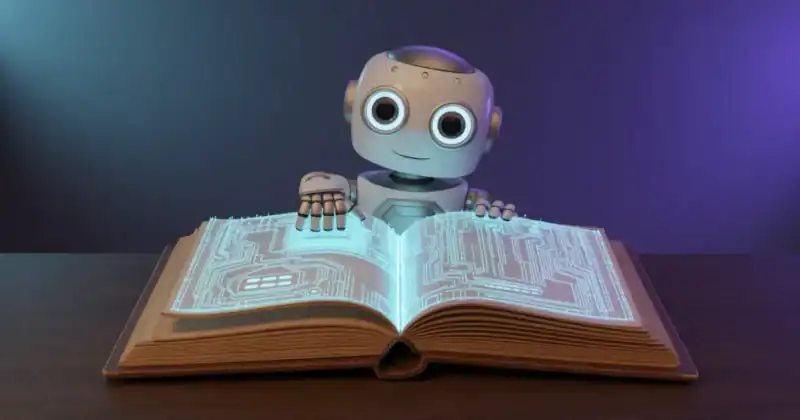
“A cute and friendly AI bot touching an old classic leather-bound book, transforming it into a glowing, digital circuit board overlaying its pages. The background is a gradient of deep blues and purples. Cinematic lighting, highly detailed, and super realistic digital art. No text.”
Based on the above prompt, Ideogram.ai created the following images. It actually created four images but I immediately dismissed one of them. I chose the last image as the featured image for this blog post.


Using AI for Book Formatting
Readable formatting is critical. Tools like ChatGPT can generate style guides, suggest headings, and even produce a clean table of contents.
For actual formatting, tools like Atticus or Vellum (Mac only) can make your book look professional in both ebook and print formats.
Prompt idea:
“Suggest a modern table of contents layout for this book. Include practical headings that make sense for today’s readers.”
Legal Notes
Public domain means you are free to use the text. However, your modern edition is an original creative work. A significant adaptation may qualify for new copyright protection. At the very least, you own the copyright on your commentary and cover design.
Always double-check the copyright status of the original work before you begin.
Recommended AI Tools
Here are some tools worth exploring:
- ChatGPT, Claude, Gemini – For text rewriting, summaries, and creating new content.
- Ideogram.ai, MidJourney, Leonardo AI – For ecovers and illustrations.
- Canva – For quick cover edits, layouts, and marketing graphics.
- Atticus, Vellum (Mac only) – For professional book formatting.
- Descript or ElevenLabs – For AI-generated audiobooks or narration.
The Human Touch: A Final Word on Your AI Co-Pilot
While AI tools can be your secret weapon, it’s important to remember they are not flawless. Think of AI as an incredibly fast, knowledgeable intern. It can handle a lot of the heavy lifting, but the final responsibility and creative vision are still yours.
Here are a few essential things to keep in mind:
1. AI Is Prone to "Hallucinations"
AI models sometimes confidently generate information that is completely made-up or factually incorrect. This is often called “hallucination.” It’s not malicious; it’s just a byproduct of how these models work.
Never blindly trust AI-generated content. Always read, fact-check, and proofread everything. Your credibility depends on it.
2. Garbage In, Garbage Out
An AI can only produce a great result if it receives a great prompt. Simply asking it to “write a chapter on courage” will likely give you a generic, uninspired response. Instead, give it a blueprint.
The more specific and detailed your instructions, the better the output. Provide the AI with a clear outline, key themes, specific examples, and even a desired word count or tone. This transforms the AI from a simple word generator into a collaborative partner that helps bring your unique vision to life.
3. Retain Your Own Voice
The most valuable product is one that blends timeless wisdom with your personal expertise.
Use AI to streamline the process, but always infuse the final text with your own voice, stories, and unique perspective. Readers are looking for your guidance and a connection with you, the author. This is especially applicable if you’re creating a totally new modern version.
You can frame your edition as “Updated and Modernized by [Your Name].” This adds credibility and helps distinguish your book from simple reprints.
By understanding these points, you can avoid common mistakes and ensure that your modernized public domain books are not just well-written, but also authentic and original.
That’s a Wrap
AI gives you the power to take a dusty classic and make it shine again. You can update the language, refresh examples, and add structure. You can also design modern covers and illustrations that capture attention.
This isn’t about stripping away history. It’s about unlocking timeless wisdom for a new generation. With AI as your co-pilot, you can create modern editions that are not only legal to sell but also valuable, unique, and marketable.
At ZeroLimits.org, we have many editable, non-fiction public domain books, ready for modernizing.
If you have had success modernizing old public domain books using other strategies or AI tools, please share your experience in the comments.

Casper du Toit
Casper du Toit is the founder and owner of ZeroLimits.org. He’s an entrepreneur and brand strategist with a passion for public domain books and a proud supporter of One Tree Planted.